



The Colorado River States are Deadlocked and the River is Crashing. Will a ‘Grand Bargain’ Finally Get its Day?
WESTERN WATER IN-DEPTH: A 'wild idea' to defuse the Colorado River Compact's legal time bomb has been kept alive by seasoned observers who believe it could still save the river
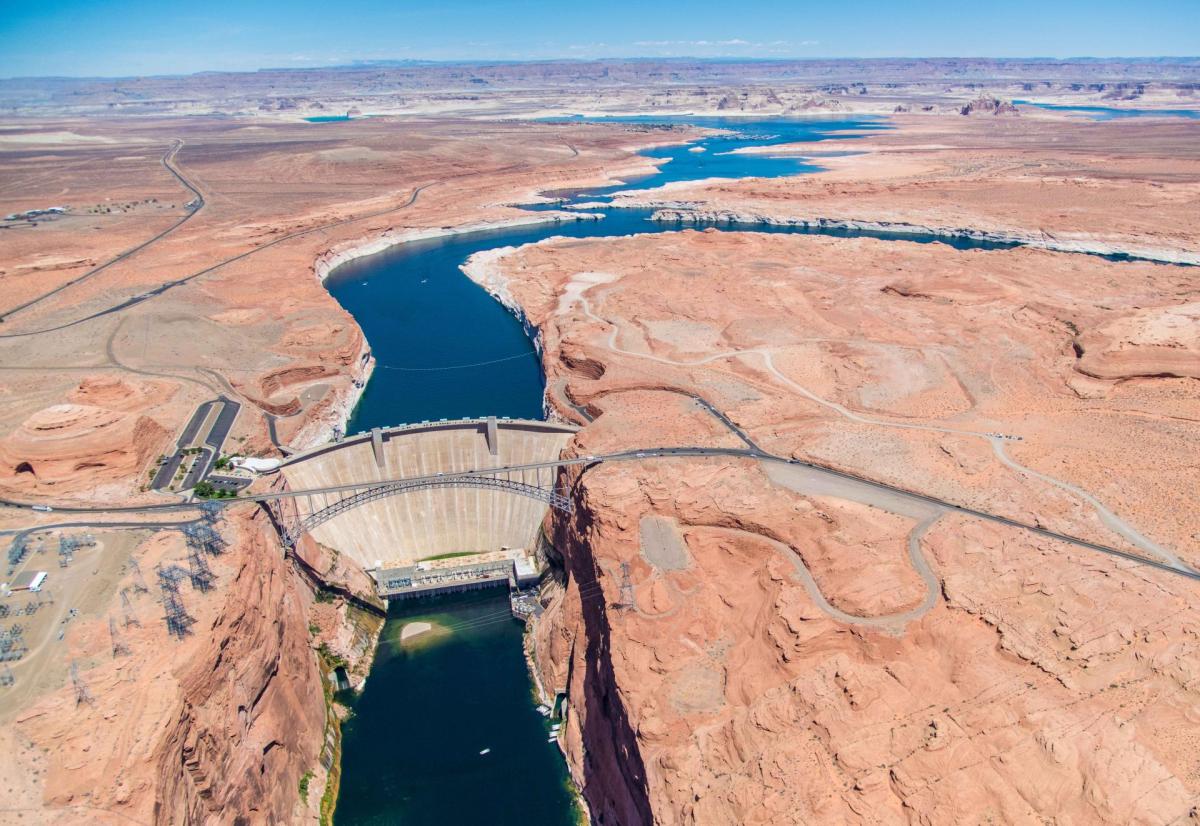 For the past 20 years, the Colorado
River has been operated under a set of guidelines negotiated
between the seven states that depend on the river. Those
guidelines expire this year, and after five years of grinding
negotiations over a new agreement, the upstream states of
Colorado, Wyoming, Utah and New Mexico remain deadlocked against
the downstream states of California, Arizona and Nevada.
For the past 20 years, the Colorado
River has been operated under a set of guidelines negotiated
between the seven states that depend on the river. Those
guidelines expire this year, and after five years of grinding
negotiations over a new agreement, the upstream states of
Colorado, Wyoming, Utah and New Mexico remain deadlocked against
the downstream states of California, Arizona and Nevada.
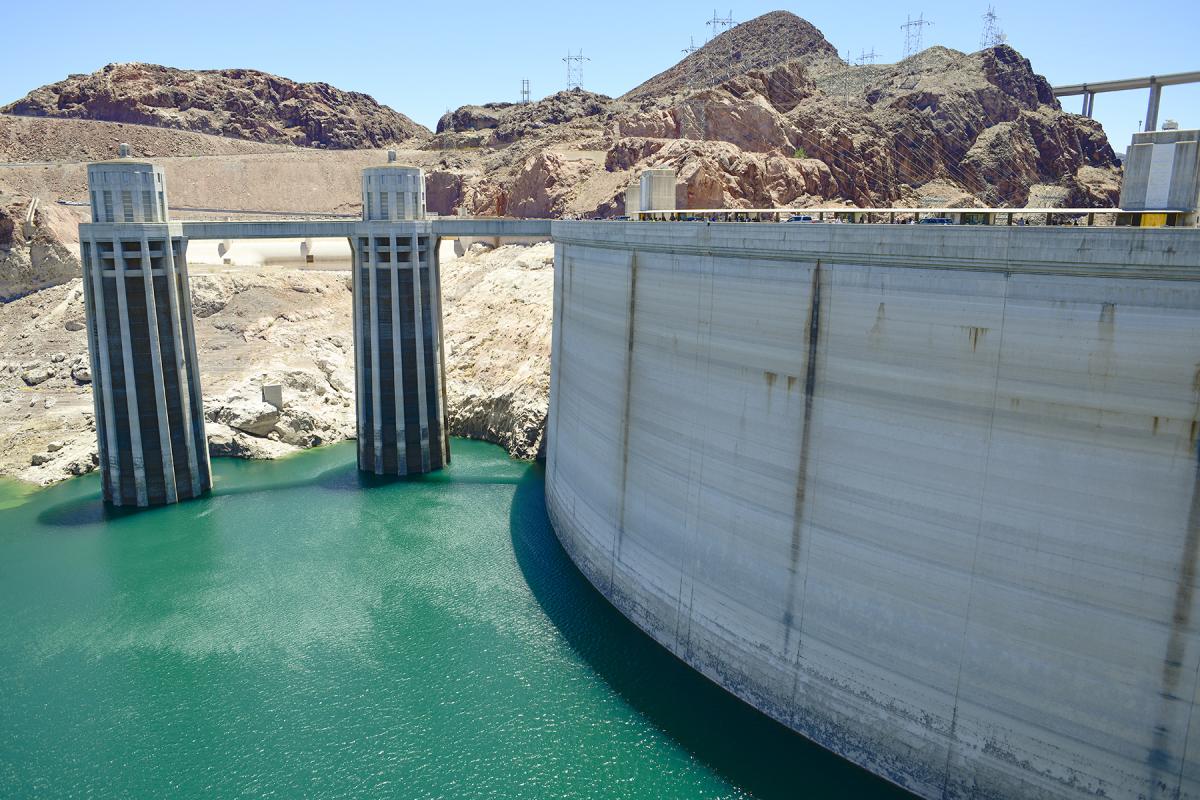
Some 40 million people and 5.5 million acres of farmland depend on the river’s water. But after the states failed to meet two federal deadlines in three months, the river is in a moment of unprecedented crisis. A dire snowpack has left flows just 15 percent of normal, many farms without water and several cities scrambling to secure water supplies as they gird themselves for shortages.
That has set up a showdown over a legal time bomb that’s been ticking away at the heart of the Colorado River Compact since the river’s guiding document was signed more than 100 years ago. The Lower Basin states believe the Compact promised them a minimum delivery of water sent down the river from the Upper Basin. The Upper Basin states believe the Compact promised them a fixed amount of water that they could rely on to meet future growth. As the river’s flows have dwindled, those two supposed guarantees are proving to be irreconcilable.
Experts have seen the showdown coming for a long time, but climate change has accelerated the day of reckoning. In 2000, a drought sunk its teeth into the river and hasn’t let up. Dubbed the Millennium Drought, it is now recognized as one of the worst droughts on the river in more than 1,200 years — and may actually be the beginning of a long-term shift to a drier reality.
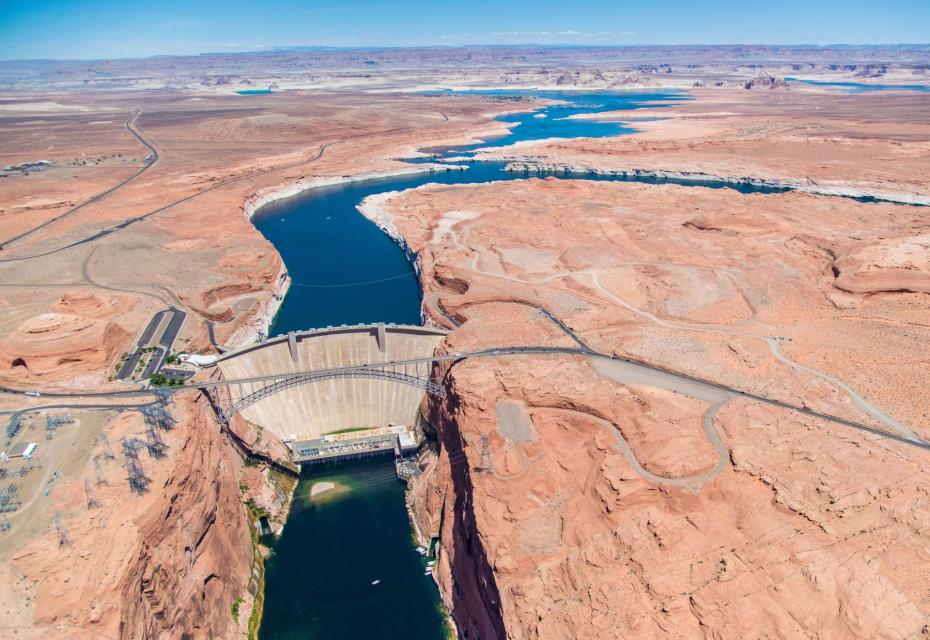
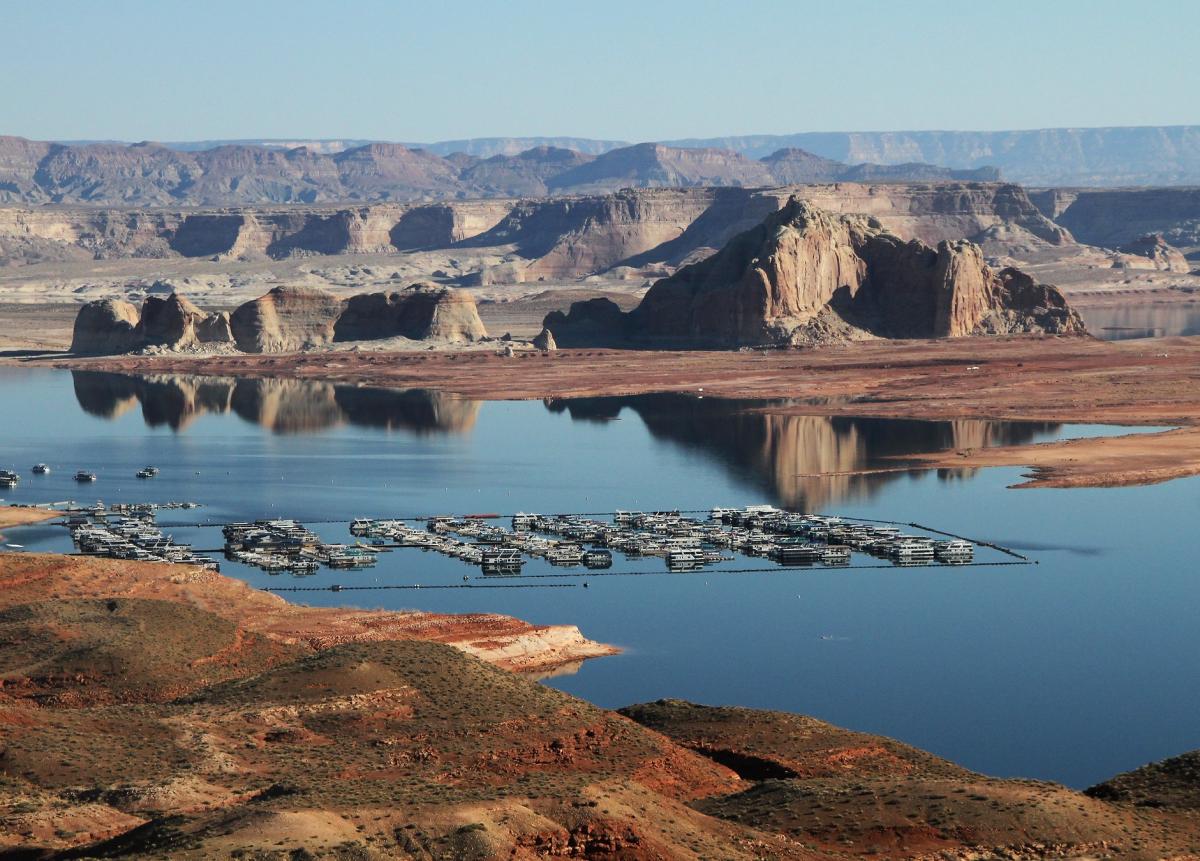
Despite near-endless negotiations to find a way to keep the river’s massive reservoir system from crashing — an effort that began over two decades ago — the drought may have finally pushed the Colorado River Compact to its limit. Now, the system is nearly empty and runoff from this winter’s snowpack, the source of any water that might offer even a small hope of relief, will be among the lowest since Glen Canyon Dam was built near the Arizona-Utah border, creating Lake Powell, more than 60 years ago. Flows in the river are perilously close to hitting the primary legal “tripwire” in the Compact. Once that’s crossed, the Lower Basin states would likely try to force the Upper Basin to deliver their water apportionment downstream — a prospect long considered unthinkable.
“All those negotiations helped push the day of reckoning back further, and helped delay the inevitable,” says Doug Kenney, who heads the University of Colorado’s Western Water Policy Program. “But at some point, you just have to acknowledge the fact that the numbers don’t add up and you’re going to have to deal with it. We’re at that point.”
Two obvious paths now lie ahead. One is a courtroom fight, either against the U.S. Secretary of the Interior or a challenge between two states under the terms of the Colorado River Compact, which would go directly before the Supreme Court. A high court case would be a doomsday scenario, a messy and protracted legal battle that, until now, the seven states desperately sought to avoid. The other potential path is a stopgap fix, a short-term interim plan negotiated between the states or imposed by the Interior secretary. That could, at least temporarily, forestall a trip to court, but it wouldn’t resolve the fundamental conflict.
For more than two decades, however, the possibility of a third path has stubbornly persisted in the background: A “grand bargain,” an idea first proposed in 2005 by Colorado’s negotiating team early in the effort to grapple with the worsening drought. The concept was an unorthodox bid to defuse the ticking time bomb — but it would require each basin to trade away its most cherished claim on the river.
‘A WILD IDEA’
Roughly 90 percent of the Colorado River’s flow originates as snowpack in the Rocky Mountains. One of the principal goals of the 1922 Compact, which is essentially a seven-state treaty, was to avoid future legal battles by creating an “equitable division and apportionment” of water between the Upper Basin states in the river’s headwaters and the faster-growing Lower Basin. The Compact apportioned 7.5 million acre-feet a year from the mainstem of the river to each basin. (An acre-foot is 325,851 gallons, enough to supply the average annual needs of roughly 3 households, depending on their location and climate.)
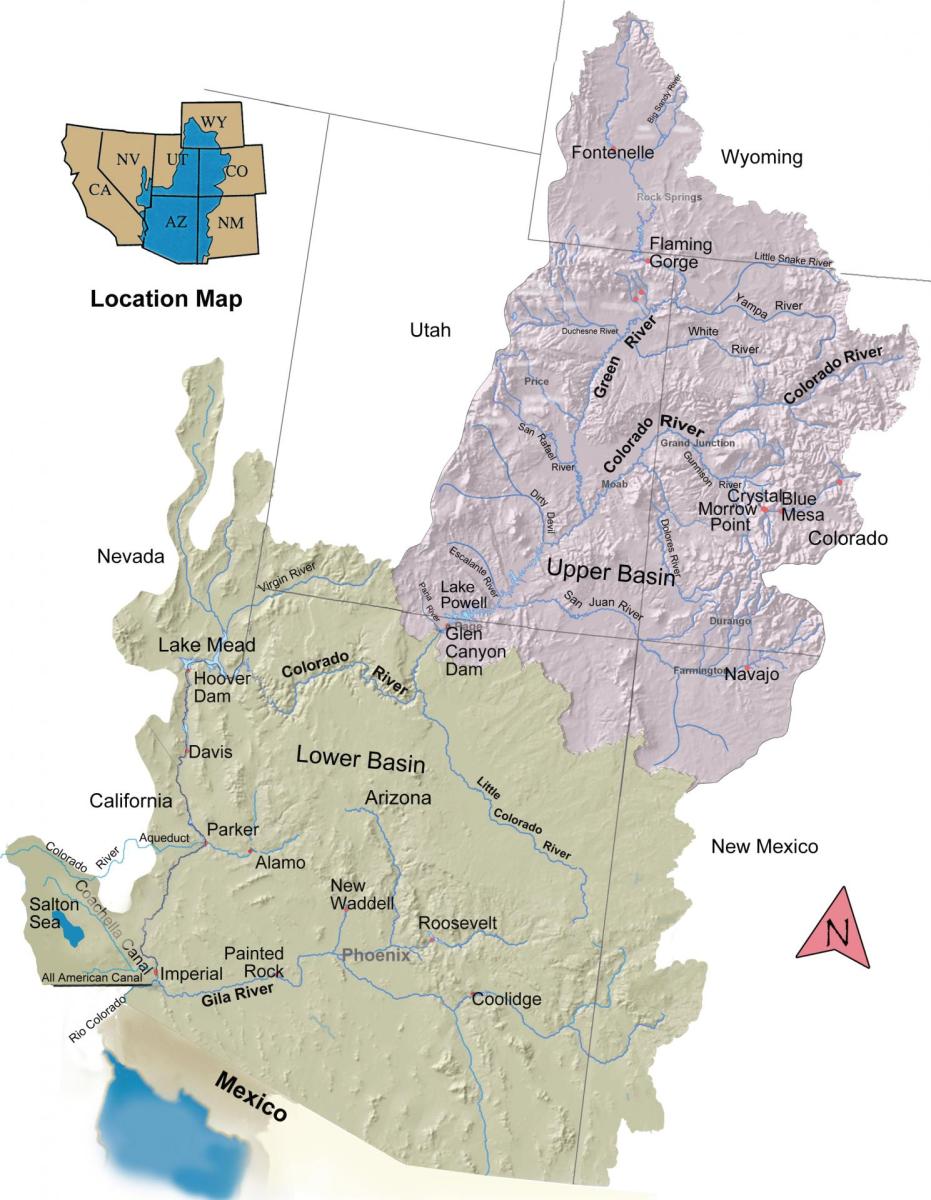 The Compact also contains a
requirement that the headwaters states not deplete the flow of
the river below 75 million acre-feet, plus another roughly 7.5
million acre-feet (half of the apportionment earmarked for
Mexico), on a 10-year running average. Those provisions were
intended to provide surety to the downstream Lower Basin states
that they would receive their 7.5 million-acre-foot annual
apportionment and that the basins would share equally in the
Mexican obligation. If the 10-year running average requirement is
violated, the Lower Basin states could — at least in theory
— initiate a Compact “call” against the Upper Basin in an
attempt to force the headwaters states to deliver more water
downstream.
The Compact also contains a
requirement that the headwaters states not deplete the flow of
the river below 75 million acre-feet, plus another roughly 7.5
million acre-feet (half of the apportionment earmarked for
Mexico), on a 10-year running average. Those provisions were
intended to provide surety to the downstream Lower Basin states
that they would receive their 7.5 million-acre-foot annual
apportionment and that the basins would share equally in the
Mexican obligation. If the 10-year running average requirement is
violated, the Lower Basin states could — at least in theory
— initiate a Compact “call” against the Upper Basin in an
attempt to force the headwaters states to deliver more water
downstream.
For roughly 80 years after the Compact was signed, the prospect of a Compact call was purely theoretical. Then the Millennium Drought set in. By 2005, the two flagship reservoirs on the Colorado River — Lakes Mead and Powell — were half empty.
The drought was pushing the river’s flows closer to a Compact violation trigger, making the risk of a call by the Lower Basin a growing probability. The Lower Basin, particularly Arizona, was insisting on guaranteed releases of water from Lake Powell. And because Colorado has the biggest share of the river within the Upper Basin and uses a greater portion of its apportionment than the other upstream states, it is most at risk. It began searching for a way to slip out of the legal noose of a Compact call.
In September 2005, the seven states’ top negotiators met in Albuquerque, New Mexico. During a lunch break, Colorado’s team made its pitch. The state’s negotiators proposed that the Lower Basin waive its right to force a downstream delivery through a Compact call. In exchange, the Upper Basin states would limit their water use to less than what’s strictly apportioned in the Compact, thereby reducing potential demand in the headwaters of Colorado and Wyoming that supply nearly the entirety of the river’s flow.
The offer was essentially a simplification and reframing of a dizzying array of technical disagreements over various provisions of the Compact — an attempt to throw spaghetti at the wall to see if it would stick.
 “My recollection was that it was a
pretty spontaneous proposal,” says Jim Lochhead, who had
previously been Colorado’s top negotiator and in 2005 was
continuing to serve as a legal advisor on the state’s team. “We
weren’t making any progress, and it was pitched as, ‘If you
really want to cut through all of this and get to the bottom,
here’s a wild idea.’”
“My recollection was that it was a
pretty spontaneous proposal,” says Jim Lochhead, who had
previously been Colorado’s top negotiator and in 2005 was
continuing to serve as a legal advisor on the state’s team. “We
weren’t making any progress, and it was pitched as, ‘If you
really want to cut through all of this and get to the bottom,
here’s a wild idea.’”
The proposal sparked discussion among all the parties at the negotiating table but also raised difficult issues.
“It was a great concept on paper,” says Pat Mulroy, who was the head of the Southern Nevada Water Authority and Nevada’s principal negotiator at the time. “Whether it was politically doable or not is a whole other ball game.”
In large part, that’s because a grand bargain would have forced both basins to give up assurances in the Compact that they consider sacrosanct.
“I’m not sure the Upper Basin would ever have agreed to limiting their ability to fully develop their 7.5. It’s like giving up your birthright — I’m not sure they could have sold that at home,” says Mulroy. Conversely, she says, “giving up that call provision is really the only weapon the Lower Basin has.”
A grand bargain “was a great concept on paper. Whether it was politically doable or not is a whole other ball game.”
~Pat Mulroy, former head of Southern Nevada Water Authority
And, indeed, following its spontaneous birth in Albuquerque, the proposal ran into stiff political headwinds back home in Colorado, where it failed to get then-governor Bill Owens’ blessing.
“I wasn’t directly representing the state of Colorado at that time; I was representing Colorado water users,” Lochhead says. “And when I brought the idea back to the state, it pretty quickly got shot down: ‘No, we can’t agree to anything that would not keep the dream alive of 7.5 million acre-feet being developed in the Upper Basin.’”
The prospect of a grand bargain itself faded from discussion. And yet, in ways that aren’t often acknowledged, it continued to shape the broad contours of the negotiations that unfolded over the next two decades.
The quest to escape the noose of a Compact call has remained central to Colorado’s bargaining position.
“The concept of a waiver of a Compact call is alive and well,” says Anne Castle, a former assistant Interior secretary who is now a senior fellow at the University of Colorado. “The quid pro quo for that waiver has taken different forms.”
To a large extent, the details of the various offers the Lower Basin has made in exchange for a possible waiver — which have sometimes been characterized within the negotiations as “mini grand bargains” — have never become public. What is clear is that the two basins have consistently failed to cut a deal.
Instead, the seven states adopted a more incremental approach, negotiating a series of drought-protection agreements based on smaller, more politically palatable deals. While that’s been a safer path for everyone politically, it has brought other kinds of risk.
“It just added layer upon layer of Gorilla Glue and Band-Aids that’s made it much more complicated to try to unwind or develop new agreements,” Lochhead says, “and has obviously proven to be inadequate in protecting the system.”
A SECOND LIFE
While the concept of a grand bargain led a short life at the negotiating table, it has gone on to live a remarkable second life. The idea was picked up and revived by a loose-knit group of seasoned observers of Colorado River issues who, for years, have called for more durable alternatives to the patchwork of ideas in play among negotiators.
Eric Kuhn was a member of Colorado’s negotiating team when the grand bargain was proposed in 2005. At the time, he was the general manager of the Colorado River Water Conservation District based in Glenwood Springs and he has written thoughtfully and voluminously about the river’s problems. After his retirement in 2018, he partnered with John Fleck, a former journalist who is now author-in-residence at the University of New Mexico’s Utton Center, to write Science Be Dammed: How Ignoring Inconvenient Science Drained the Colorado River.
Kuhn and Fleck concluded the book by observing that “there is not enough water in the Colorado River for all the lawyers to be right,” and suggested the grand bargain as a way to avoid the courtroom.
“The basic idea of a grand bargain is, in lieu of litigation, we’re going to agree to something that both sides want,” says Kuhn.
He and Fleck weren’t the only ones who pushed for more serious consideration of the idea. Doug Kenney at the University of Colorado also has championed the concept. In 2012, he enlisted Kevin Wheeler, a widely respected engineer and fellow at Oxford University, to undertake modeling analysis of the kinds of trade-offs a grand bargain might require.
 In 2021, Wheeler — together with a
group of collaborators including Kuhn, climate scientist Brad
Udall and Jack Schmidt, the director of Utah State’s Center for
Colorado River Studies — published a white paper called
“Alternative
Management Paradigms for the Future of the Colorado and Green
Rivers.” It was a comprehensive assessment of more ambitious
strategies for weathering the drought and climate change than had
emerged from now-perpetual negotiations between the states.
In 2021, Wheeler — together with a
group of collaborators including Kuhn, climate scientist Brad
Udall and Jack Schmidt, the director of Utah State’s Center for
Colorado River Studies — published a white paper called
“Alternative
Management Paradigms for the Future of the Colorado and Green
Rivers.” It was a comprehensive assessment of more ambitious
strategies for weathering the drought and climate change than had
emerged from now-perpetual negotiations between the states.
“New approaches that are responsive to significantly drier climate conditions and changing patterns of consumptive uses may require bolder policy initiatives that exceed the incremental approach of modern management,” the group wrote. “It is critical to explore alternative water management strategies that may extend beyond the framework of the Law of the River as presently interpreted.”
The following year, the team published a paper in the journal Science titled “What Will it Take to Stabilize the Colorado River?” And, it turned out, stabilizing the system would take something that looked a lot like a grand bargain.
Assuming the drought persists as it has since 2000, Wheeler and his partners identified two scenarios that would stabilize the river, both of which assumed the Lower Basin had waived its ability to make a Compact call. In one, the Lower Basin would need to decrease its water use by about 2 million acre-feet a year when Lake Mead and Lake Powell reach low levels. That would assure it of about 78 percent of its apportionment — an amount roughly in line with cuts it has already committed to taking. In exchange, the Upper Basin would have to cap its water use at 4 million acre-feet. But that’s only slightly more than half of its 7.5 million-acre-foot Compact apportionment, and roughly 300,000 acre-feet less than what it currently uses.
The second scenario — call it the “near-parity scenario” for simplicity — more equally distributed the Upper and Lower Basins’ relative cuts in apportionment. In it, the Upper Basin would cap its use at 4.5 million acre-feet, leaving it with 60 percent of its Compact apportionment. The Lower Basin would be able to use about 67 percent of its Compact apportionment when reservoirs are low, just slightly more percentage-wise than the Upper Basin. But it would have to cut its uses by 3 million acre-feet below its apportionment.
That would stabilize the system — or at least go a long way toward doing so — while largely meeting existing water demands in both basins. The Upper Basin currently uses about 4.3 million acre-feet per year. The Lower Basin, after ramping up an aggressive water conservation effort since 2007, has driven its annual use down to about 6 million acre-feet per year, and has signaled that it could likely reduce demand further.
But it would leave practically no leeway for future growth, at least without reshaping the socioeconomic landscape across the entire Basin. In particular, any future urban growth could come only by shifting significant amounts of water from farms to cities.
HARD MATH
Today, there is a simple, hard reality on the Colorado River: The available water supply is already maxed out. Water use throughout the basin needs to be reduced by roughly 25 percent just to make the numbers work now — to say nothing of the future, which is likely to be significantly drier.
In Colorado, that has raised hard questions about fairness, the “equitable division and apportionment” provision of the Compact, and the assurance the state thought it had that its water would be there to develop when it’s finally ready.
“Everyone agrees that there should be an equitable division of water…. But does equitable mean equal? That’s the crux of the issue.”
~Doug Kenney, University of Colorado’s Western Water Policy Program
“Everyone agrees that there should be an equitable division of water, and the word ‘equity’ is one that everyone will rally around,” says Kenney. “But does equitable mean equal? That’s the crux of the issue.”
Over the past several years, Colorado’s attorney general, Phil Weiser, has been building his office’s staff of water lawyers. This January, Weiser, who is currently running for governor, appeared before a joint hearing of the state legislature’s judiciary committees.
“If we can’t get a deal — and I’m committed to not getting a bad deal just to get a deal — we’ll be in litigation. We’re ready for it,” he said. “If and when we can get a reasonable deal based in reality, I’m for it. But if we can’t, then we will be falling back on our rights under (the) 1922 Compact.”
Because of the peculiarities of the water-rights hierarchy in the Lower Basin, Arizona is arguably most at risk there. In March, that state — whose governor, Katie Hobbs, is running for re-election — retained the high-powered law firm Sullivan & Cromwell to represent it in potential Colorado River litigation. At the time, a spokesman for the governor said, “it’s critical that Arizona be prepared to defend ourselves in court if an agreement cannot be reached or the Law of the River is violated.”
 “It is very difficult for a
political figure — and they’re all political figures, even if
they’re not elected — to agree to reduce the water use of their
constituents and keep their career alive,” says Anne Castle.
“They have to be able to tell their constituents, ‘I’m fighting
for your water. I’m doing everything I can to keep your water
secure, and it’s the other guy’s fault.’ The political incentives
are directly at odds with the kind of compromise that’s needed in
this type of hydrologic situation.”
“It is very difficult for a
political figure — and they’re all political figures, even if
they’re not elected — to agree to reduce the water use of their
constituents and keep their career alive,” says Anne Castle.
“They have to be able to tell their constituents, ‘I’m fighting
for your water. I’m doing everything I can to keep your water
secure, and it’s the other guy’s fault.’ The political incentives
are directly at odds with the kind of compromise that’s needed in
this type of hydrologic situation.”
Following the breakdown in negotiations between the Colorado River states, the federal government has announced its intention to step in. In May, the Bureau of Reclamation, on behalf of the Department of the Interior, revealed that it is preparing the first of what could be a series of five two-year interim plans for the river.
The final details are expected to be released this summer. But the federal government has indicated that the Interior secretary could cut water deliveries to the Lower Basin states by up to 3 million acre-feet — 40 percent of their Compact apportionment. During a briefing for Arizona water users in May, Brenda Burman, the head of the Central Arizona Project, presented modeling analysis of the proposed reductions and noted that, given the diminished releases from Lake Powell, the Upper Basin is “in a definite breach of the Compact by Sept. 30 of 2026.”
Owing to some quirks of river history, the secretary debatably has less authority in the Upper Basin, and so Reclamation has proposed no cuts there. But as climate change continues to eat away at snowpack and river flows, the Upper Basin states will likely be forced to cut back their uses anyway. Regardless of what the Compact says the Upper Basin gets, the water simply won’t be there.
And so now the seven states are facing a situation eerily similar to those in the near-parity scenario Wheeler and his colleagues laid out in their Science paper four years ago — but without a bargain.
COMING FULL CIRCLE?
In many ways, the prospects have never been worse for something like a grand bargain. Yet the fundamental problems the grand bargain was intended to solve have only grown sharper in the 20 years since it was first proposed.
“The grand bargain has gotten a bad name,” Kuhn says. “But if these issues aren’t resolved through a grand bargain, they’re going to be resolved through litigation.” In 2007, he says, the river’s reservoirs still had ample water to work with. “With empty reservoirs, you cannot finesse these issues.”
 Litigation could come as soon as
August, when Reclamation will likely release a record of
decision for its proposed new operating plan. Legal action
could take one of several paths. The one with the highest stakes
would be direct enforcement of the Compact, likely in the form of
a Compact call brought by Arizona and the other Lower Basin
states against the Upper Basin states. Because the Compact is
essentially a treaty between multiple states, that would go
directly before the Supreme Court. But such cases are often
grindingly long: Arizona’s 1952 lawsuit against California over
Colorado River rights took a dozen years to resolve. A case in
the Supreme Court could put the river in protracted litigation
during a time of profound crisis.
Litigation could come as soon as
August, when Reclamation will likely release a record of
decision for its proposed new operating plan. Legal action
could take one of several paths. The one with the highest stakes
would be direct enforcement of the Compact, likely in the form of
a Compact call brought by Arizona and the other Lower Basin
states against the Upper Basin states. Because the Compact is
essentially a treaty between multiple states, that would go
directly before the Supreme Court. But such cases are often
grindingly long: Arizona’s 1952 lawsuit against California over
Colorado River rights took a dozen years to resolve. A case in
the Supreme Court could put the river in protracted litigation
during a time of profound crisis.
Other, more limited challenges are possible, most likely against the Bureau of Reclamation or the secretary of the Interior for failure to comply with the Compact or violating environmental laws. But they, too, are not without risk.
“I have a hard time believing you could keep litigation contained, once that genie’s out of the bottle,” says Kenney. “I just have to believe that inevitably blows up into a full-fledged interstate litigation and it bumping right up to the Supreme Court.”
As the odds rise of a legal challenge to the Compact that could ultimately wind up before the highest court in the land, the fundamental tension the grand bargain was intended to resolve will likely be front and center before the justices. And, paradoxically, that could force the states themselves to finally make the really tough sacrifices they’ve been trying to avoid.
“I think that a road to a grand bargain runs through litigation,” says Kuhn.
That’s because in past interstate fights over shared rivers, the Supreme Court has typically appointed a water-law expert known as a special master to referee such cases. The most recent example is the dispute between Texas, New Mexico and Colorado over the Rio Grande. In that case, Kuhn notes, “the special master said, ‘You don’t want me or the court to decide this; get in a room and negotiate it.’ The special master kept the pressure on the states to negotiate.”
This May, the Supreme Court approved a settlement between those three states. Still, even that resolution only came a full 13 years after the case was initially filed, and it involves relatively small reductions in overall water use.
On the Colorado River, both water and time are in far shorter supply.
Western Water, our flagship publication by Foundation journalists, is available online. Check out our latest articles. Reach writer Matt Jenkins at mjenkins@watereducation.org.
Know someone who wants to stay connected to water in the West? Encourage them to sign up for Western Water and follow us on LinkedIn and Instagram.
Further Reading From Western Water
- As Colorado River Negotiations Near a Critical Deadline, a New Way of Looking at Risk is Revealing Hard Choices, Sept. 25, 2025
- Changes Loom for Innovative Lower Colorado River Endangered Species Program Amid Drought, New River Rules, April 17, 2025
- Tribes Gain Clout as Colorado River Shrinks, Nov. 16, 2023
- As Colorado River Flows Drop and Tensions Rise, Water Interests Struggle to Find Solutions That All Can Accept, Dec. 9, 2022
- As Climate Change Turns Up The Heat in Las Vegas, Water Managers Try to Wring New Savings to Stretch Supply, June 25, 2021
- Milestone Colorado River Management Plan Mostly Worked Amid Epic Drought, Review Finds, Nov. 20, 2020
- Questions Simmer About Lake Powell’s Future As Drought, Climate Change Point To A Drier Colorado River Basin, May 15, 2020
- With Drought Plan in Place, Colorado River Stakeholders Face Even Tougher Talks Ahead On The River’s Future, May 9, 2019