Water and energy are interconnected. A frequent term to describe
this relationship is the “water-energy nexus.”
Energy for Water: Energy is needed to store water, get it where
it is needed and also treat it to be used:
* Extracting water from rivers and streams or pumping it
from aquifers, and then conveying it over hills and into storage
facilities is a highly energy intensive process. The State Water
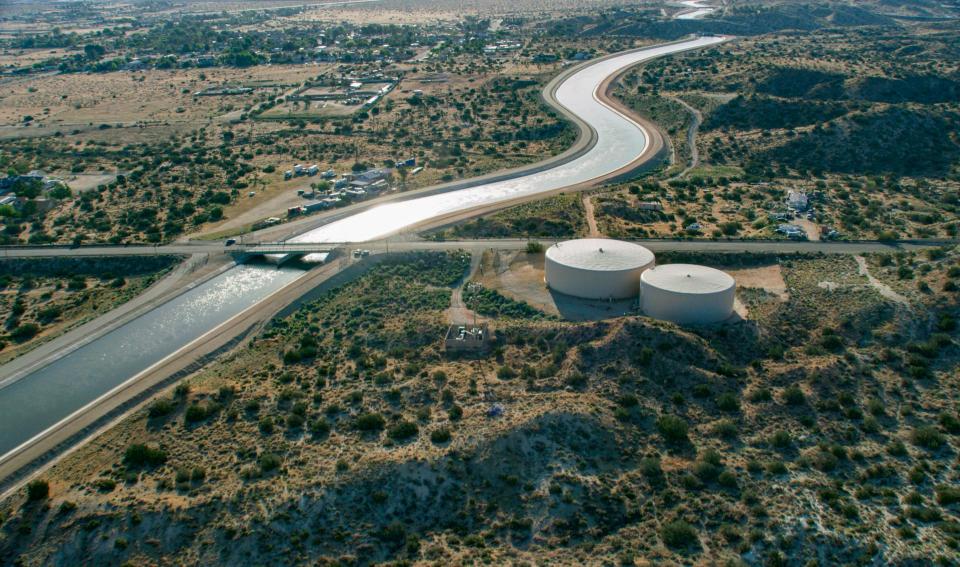
Project (SWP) pumps water 700 miles, including up nearly 2,000
feet over the Tehachapi Mountains. The SWP is the largest single
user of energy in California. It consumes an average of 5 billion
kWh per year. That’s about 2 to 3 percent of all electricity
consumed in California
* Water treatment facilities use energy to pump and process
water for use in homes, businesses and industry
* Consumers use energy to treat water with softeners or
filters, to circulate and pressurize water and to heat and cool
water
* Wastewater plants use energy to pump wastewater to
treatment plants, and also to aerate and filter it at the plant.
Different end uses require more electricity for delivery than
others. Water for residential, commercial and industrial end-use
needs the most energy (11 percent), followed by agricultural
end-use (3 percent), residential, commercial and industrial
supply and treatment (3 percent), agricultural water supply and
treatment (1 percent) and wastewater treatment (1 percent),
according to the California Energy Commission.
Water for Energy: Water is used to generate electricity
* Water is needed either to process raw materials used in a
facility or maintaining a plant,or to just generate electricity
itself.
Overall, the electricity industry is second only to agriculture
as the largest user of water in the United States. Electricity
production from fossil fuels and nuclear energy requires 190,000
million gallons of water per day, accounting for 39 percent of
all freshwater withdrawals in the nation. Coal, the most abundant
fossil fuel, currently accounts for 52 percent of U.S.
electricity generation, and each kWh generated from coal requires
withdrawal of 25 gallons of water.
Data centers can look like little more than large, windowless
warehouses. But the questions they create for a city can extend
far beyond where to put the building, or if beauty is indeed in
the eye of the beholder. … For Alison McNally, who teaches
geography and environmental resources at Stanislaus State, one
question immediately rises to the top in the San Joaquin
Valley: “Where would the water come from?” The
region already has competing demands from agriculture, homes,
businesses and environmental needs, while groundwater users are
adjusting to California’s Sustainable Groundwater Management
Act. McNally said the impact of any particular data
center would depend heavily on its size, location and water
source.
The corporate technology giants building data centers to power
the artificial intelligence boom are changing America’s natural
landscape. Although data centers long predate generative AI,
hundreds of massive, or “hyperscale,” facilities are now
sprouting up around the country. Many of these data centers are
going up in areas that were once farmland or desert.
… The surge in data center construction has sparked
significant public backlash, with communities citing concerns
about their impact on local water and power supplies, among
other issues. … Thirty states have introduced or adopted
legislation or taken other actions to address some of these
concerns, including the impact of data centers on utility
costs.
Conservationists sued the Trump administration Tuesday to
challenge the expansion of a heavy metal mine they say will
carve up one of Arizona’s ecologically important mountain
ranges. In consultation with the U.S. Fish and Wildlife
Service, the U.S. Forest Service approved the expansion of
Australian company South32 Hermosa’s mineral extraction
operations to 52,438 acres in the Patagonia Mountains
of southern Arizona. … The plaintiffs claim the
Forest Service also violated the National Environmental Policy
Act by failing to provide an adequate analysis of the project’s
threats, including its effects on groundwater and other public
resources. … Groundwater pumping would draw down
the water table by as much as 250 feet and may reduce
or even eliminate surface water flows.
Pima County staff held an open house downtown Monday, to
discuss the proposed rules. The meeting came just days after
the county approved a 120-day moratorium on new data center
developments. Currently, Pima County only allows data centers
in its most intensive industrial zones The proposed rules would
formally define what data centers are and establish guidelines
regarding the energy and water used by data centers as well as
noise levels. … Under the draft regulations, the county
would require data centers to use closed-loop water cooling
systems. This technology allows water to be recirculated and
reused. Projects would also need certified access to an
adequate supply of both water and energy.
A tech developer has asked a Nye County judge to toss out a
ban on data centers in one of the state’s most
overstressed water basins that serves Pahrump. In a
statement, developer Sean Dalesandro said his company is asking
for a judge to uphold a principle of fairness, adding that he
believes the ban unlawfully disregarded a significant
investment into zoning. His company’s previously proposed data
center project, the Manse Technology Campus, drew protests from
hundreds of residents. … The legal petition is in
response to a ban on data centers in basin 162, the
Pahrump Valley Hydrographic Basin, where water rights
committed on paper to property owners outweigh
the annual yield by more than three to one.
U.S. Rep. Teresa Leger Fernández (D-N.M.) on Thursday issued a
call for a “pause” on data centers in New Mexico, and released
a set of standards she said such developments should meet
before receiving approval. … Leger Fernández’s
announcement also comes as state lawmakers gear up to consider
a data center moratorium during next year’s legislative
session. … Leger Fernández, in a news release, said data
centers should abide by certain provisions if elected, which
she titled the No Blank Checks for Data Centers Principles.
Those principles include being able to demonstrate that a data
center won’t increase electricity bills or negatively impact
water resources and must meet the state’s renewable energy
requirements.
Two New Mexico Supreme Court rulings will
allow water to flow and permitting to continue for
the Project Jupiter data center, which is
currently under construction. Meanwhile, one of the
conservation groups that lost its effort to cut off the water
says it is gearing up for a long legal fight. The site is
being built by Oracle and is expected to house
OpenAI, known for its ChatGPT platform. … The
recent rulings restore Oracle’s access to non-potable
groundwater via a private supplier. The Center for
Biological Diversity sued New Mexico State Engineer Elizabeth
Anderson in one case over water use, and the group New Energy
Economy sued New Mexico Environment Secretary James Kenney in
another, over air quality permitting.
Gilbert leaders want strict rules on data
centers, making it as hard as possible for the massive
server farms to set up shop in town. Councilmembers were
expected to take up those new rules in September. However, a
town spokesperson said the new rules won’t be addressed until
sometime in October or November. The move comes amid
pushback from residents across the Valley and the
country about data center development raising concerns about
pollution, water and energy use. Arizona Attorney
General Kris Mayes called for a halt to new data center
development in late August, citingColorado River water cuts, and a new state law
in June that put a three-year moratorium on tax breaks for data
center development.
Beneath the Rocky Mountains, the Sierra Nevada, and the deserts
in between, lies a massive energy source — and it isn’t a
fossil fuel. The smashing and separating of tectonic plates
that produced many of the West’s most dramatic landscapes have
also allowed heat from the planet’s core to rise nearly to the
surface. Now, an explosion of new geothermal energy companies
wants to drill into the Earth and capture that heat for clean
electricity. … These new geothermal projects are located
in dry Western states because of their geology, but they face
an ironic practical challenge: Most new geothermal technologies
need water to produce power. … A company called XGS
Energy is trying to provide geothermal energy that requires
nearly no water to New Mexico, which is currently suffering a
decades-long drought.
… Project Nexus tests not one, but three different solar
canal models. A wide-span canopy rises over one of Turlock’s
115-foot canals, resembling the top of a barn. A more classic
set of slanting solar panels sits atop a 20-foot canal. And
accordion-like retractable panels are positioned low across the
narrow canal, ready to roll up at a moment’s notice.
… Roger Bales, a professor at UC Merced who co-authored
a 2021 study that helped convince the state to invest in this
pilot, said his initial calculations indicate that putting
panels over 100 miles of Turlock’s narrow canals could
save enough water for 2,700 households annually.
… Bales said shading the canals led to less
algal growth and less fixed aquatic weed growth — reducing
maintenance and improving water quality.
Gov. Gavin Newsom signedseven new data center regulations into
law Monday, as public concerns about the facilities’ demands
for water and electricity have reached a fever pitch. Newsom
signed a raft of bills that require data center
operators to report their water consumption and pay
for upgrades to offset any increased electricity grid demands.
… One of the measures was a resurrected measure from
Assemblymember Diane Papan, D-San Mateo. The governor vetoed a
similar bill last year that would have required data centers to
disclose their water usage when applying for licenses.
In Silicon Valley’s biggest city, residents and environmental
groups are organizing against a wave of proposed data center
projects that officials have courted in a bid to position the
city as a hub for AI infrastructure. The clash highlights a
challenge confronting policymakers nationwide: how to support
an industry viewed by government and business leaders as
critical to economic competitiveness while responding
to growing public concerns about the electricity, water and
pollution impacts of the infrastructure required to
power it. … The fight comes as California Governor Gavin
Newsom weighs a package of bills intended to
protect state residents from the costs of powering data centers
and increase transparency around their energy and water
use.
… [Iron] county has been developing a new ordinance for
approving such projects and other large developments like
natural gas plants or solar farms. The proposed rules
would cap water use for most data centers at 50,000
gallons per day, set limits on noise and light
pollution, require more efficient cooling systems and give the
county more control over where those projects can be built.
… Developers would have to meet criteria governing where
projects could be built and how close they can be to homes,
show that water, power and transportation are available
nearby, and minimize impacts on the environment or
agriculture. … If a project needs more than 56 acre-feet
per year, a developer could acquire more water
rights, retire them and use that as credit for more
water use, according to the draft ordinance.
Colorado communities are moving ahead with approvals of massive
new data centers, even as new public polling shows citizen
opposition swelling over concerns about electricity and
water use and noise. … The Weld
County Commission is embracing data growth, approving on Sept.
9 a plan from Global AI that would become the largest
data center operation in the state. … The commission
had earlier this year approved a set of special planning and
permitting rules for data centers, banning development in
agricultural zones and requiring water conservation
plans and adequate power sources. … While many
local residents objected to the Global AI approval, the
commissioners said they were adding important limitations on
the developer, requiring a closed-loop cooling system
that needs far less water use than many existing data
centers.
A federal judge appears split on a bid to stop the expansion of
a pit mine in eastern Arizona that has reduced the flow of a
nearby creek by more than 90% in the last decade. The Pinto
Valley Mine uses more than 5 trillion gallons of water per
year, extracting copper from the Tonto National Forest east of
Miami, Arizona, and consequently reducing subflow of Pinto
Creek, home to at least two species of endangered birds.
Because the mine extracts most of its water from privately
owned wells on private land outside Forest Service
jurisdiction, the government claims it has no authority to
limit how much water the mine can pump. In a Phoenix courtroom
Tuesday afternoon, Thomas Delehanty said the federal government
can and should regulate activity on private land if the result
of that activity materially harms conditions on nearby public
land.
From neighborhood protests to countywide moratoriums, water-
and energy-intensive data centers have united protesters who
distrust the industrial behemoths. … There are now
more than 70 data centers either operating in or
planned for Nevada, but as more are planned, Nevadans
across the state are turning out in droves at public meetings
to speak against their construction. … Water
consumption per data center varies. … City of Reno
planning numbers forecast the Keystone and Webb data centers —
which are on the “smaller” side for data centers, requiring
less than 30 megawatts of power per project — will each require
around 650,000 gallons of water a year. … Across
Southern Nevada, data centers account for about 0.5
percent of water usage. Golf courses account for more than 5
percent while casinos use 7 percent.
In a rugged, sparsely populated patch of Arizona, there’s a
fragile system of rivers and creeks that cuts through
the desert. The San Pedro River and its tributaries,
locals and environmentalists say, are a unique gem. Now,
they’re sounding the alarm about a number of potential
threats to its water and surrounding ecosystems.
Residents are pushing back on a number of proposed
developments, including two mining projects, a natural gas
pipeline and a petroleum pipeline. Organizers say they could
harm the San Pedro, one of the last undammed,
free-flowing rivers in the Southwest, and the Aravaipa
Canyon area, a striking section of wilderness that attracts
tourists from around the state. Melissa Crytzer Fry, chair of
the board of directors for the Lower San Pedro Watershed
Alliance, said new mining activity could pose a “grave danger”
by leading to over-pumping of groundwater.
Municipalities across the Grand Canyon State are raising
concern over the rapid rise of data centers,
especially when it comes to water consumption in the
drought-stricken Southwest. But an Arizona tribe that
shares a 108-mile border with the Colorado
Riverhas enacted a moratorium on its nearly 1
million-acre reservation. The Hualapai Tribal Council
in northern Arizona recently passed a resolution opposing “the
irresponsible development of hyperscale data centers.” Such
facilities powering AI, they say, pose “a direct and severe
threat to the tribe’s sacred water, lands, environment and way
of life.” … According to the city’s project FAQ webpage,
Page has not committed any municipal water source to the
pending data center — adding that rumors about drawing from
Lake Powell remain “speculative at this time.”
An Amazon data center under construction in Gilroy is
frustrating a local transparency group and residents who
are voicing concerns about the city’s lack of openness in
allowing the project to move forward. Americans for
Transparency, a grassroots initiative led by Gilroy resident
Georgine Scott-Codiga, filed a formal demand of violations with
Gilroy asking for an admission that the land where the Amazon
data center is being developed has allegedly violated the
California Subdivision Map Act. … Scott-Codiga wants four
issues addressed by the city attorney and Gilroy City Council:
stop accepting Amazon’s water connection applications until the
subdivision issue is resolved; formally investigate whether the
Amazon parcel was illegally created; refer the matter to Santa
Clara County for enforcement; and notify Amazon in writing no
approvals will be issued until the alleged parcel defect is
corrected.
As Gov. Gavin Newsom weighs whether to require data centers to
disclose how much water they use, OpenAI CEO Sam Altman says
concerns over AI’s water use don’t hold “up to any
scrutiny.” On the Sources Podcast with Alex Heath
released Tuesday, Altman said that it takes 38,000 ChatGPT
queries to use as much water as producing a single almond in
California. … The problem, experts say, is that it’s
impossible to verify those numbers given what’s public about
the secretive industry. … Regardless of whether it takes
thousands of queries to match the water needed to produce a
single almond in California (a number that varies substantially
over time and space, according to a 2019 study), the
Congressional Research Service says data centers are using more
water than they used to.
California lawmakers passed seven bills aimed at
increasing oversight of data centers in the final days
of the legislative session and sent the measures to Gov. Gavin
Newsom for consideration. Among the bills are proposals from
Bay Area Assemblymembers Diane Papan and Rebecca Bauer-Kahan
that would require greater disclosure of water and
energy use by data center operators. … Papan’s
legislation focuses on water use before and after a data center
begins operating. One bill would require developers to disclose
projected water use. “It requires data centers to inform
localities of how much water they’re going to use prior to
construction,” Papan said.
Water use for data centers across New Mexico could soar in the
coming years, an analyst told state lawmakers Monday.
Currently, data centers in the state use just more than
500 million gallons of water annually, accounting for
one-half of 1% of the state’s total water use, Houston Advanced
Research Center Vice President of Water and Community
Resilience Margaret Cook told legislators on the interim Water
and Natural Resources Committee. If every data center planned
for the state was up and running, that figure would
jump to 23.6 billion gallons per year, she said. The
lion’s share of that water would go toward “indirect
use,” such as cooling the power plants that fuel the data
centers, Cook said. A lack of transparency from data
center developers makes it difficult to accurately predict
future water use numbers, she added.
As fights about data centers erupt nationwide, California
lawmakers have approved a pair of bills to make data center
developers disclose how much water they really
use. The bills are a new test of whether
California will set limits on an industry that’s becoming a
flashpoint over water, electricity and the environmental
consequences of artificial intelligence. Lawmakers on
Monday cleared Assembly Bill 2469 by Assemblymember Diane
Papan, a Democrat from San Mateo. The bill bars local
governments from approving new or expanded data centers
unless the developer discloses its water plans and
covers the full cost of any new water pipes, treatment or
storage for the facility. … It’s almost
identical to a bill Papan authored last year, which Newsom
vetoed amid pressure from the tech industry.
Kern County has collected $4,076,000 from oil permits issued
since the start of the year as part of its strategy to
help disadvantaged communities with failing water
systems. But it can only actually spend $9,592 of
that, so far. That’s because, until oil companies begin the
drilling process– known as spudding in – the $9,732 water fee
charged as part of county permits doesn’t technically belong to
the county, explained Planning Director Craig
Murphy. “It’s held in trust while the oil company works to
get its permits from CalGEM (California Geologic Energy
Management), and then get all its equipment, financing and
people in place,” Murphy said. “Once they notify the county
that they’re activating the permit, that triggers the
money to be transferred into the Disadvantaged Communities
Water Relief Fund.”
After weeks of intense negotiation, state lawmakers on Friday
reached a compromise on legislation to regulate energy use by
California’s growing data center industry, action triggered by
community anger over the facilities and fears of high utility
bills in some communities. The goal, according to legislators
and advocates, is to protect consumers from growing electricity
costs driven upward by the sprawling facilities and to
track the centers’ immense energy and water
consumption. … Separate bills that would
require the centers to disclose their energy and water
use were recently approved by state lawmakers.
After Gov. Gavin Newsom vetoed her data center water
disclosure bill last year, Assemblymember Diane Papan,
D-San Mateo, returned this year with a two-bill package. One of
the bills, AB 2619, was passed by the Legislature Thursday
morning, sending to Newsom a measure that would require
data centers to report their water consumption
annually. The other bill, AB 2469, which would require
information about projected water demand before new
data centers are approved, is still moving through the
Legislature. … Opponents have argued that existing state
law already gives local water agencies the information they
need to plan for new development and that additional reporting
requirements would place unnecessary burdens on the industry.
Pinal County supervisors on Wednesday rejected plans to build
La Osa Energy Center, a massive development planned outside
Eloy. It was among the largest proposed data centers in
Arizona. … The rejection comes even after the
developers proposed an 80% reduction in the original scale of
the project, self-imposed limits on water use
and a commitment to shoulder all of the energy costs.
… Between the last public hearing in May and Wednesday’s
vote, Vermaland added 22 new development conditions. These
included a 600 acre-foot cap on fresh water
use within the data center buildings — close to 200
million gallons worth of water — and at the on-site natural gas
plant. Vermaland said it would consider offsetting
some of this consumption by purchasing effluent water,
but didn’t mention firm requirements.
U.S. Rep. Gabe Vasquez (D-N.M.) on Tuesday announced he had
co-sponsored two federal bills aimed at data center
transparency. Vasquez signed on as a co-sponsor to the FAIR
Data Act, sponsored by Rep. Josh Riley (D-N.Y.), and the Data
Center Water and Energy Transparency Act of 2026, sponsored by
Rep. Lauren Underwood (D-IL). The FAIR Data Act would shield
residential electric customers and small businesses from
shouldering increased energy costs related to large data
centers. The Data Center Water and Energy Transparency
Act of 2026 would require developers to provide state
and local governments that have data centers, or are
considering them, with information pertaining to energy
and water consumption. Companies that don’t comply
would face fines of up to $20,000 per day.
Electric power generation for data centers is a threat to
water supplies even in states outside the arid
Southwest, according to a report published Tuesday by
the think tank Ceres. Data centers in the seven states with the
highest concentrations of them use about 3.4 trillion
gallons of freshwater for electric power generation every
year, but few electric power producers have connected
increasing power demand to water supply risks, says the report,
“The Water Behind the Watts.” That volume of water adds up to
10.4 million acre-feet—greater than the 8
million-acre-foot average annual urban water demand in
California that the state’s Legislative Analyst’s
Office reported in 2021. It’s the equivalent to 12-times the
annual water use of Los Angeles, Phoenix, and Washington, DC,
combined, the think tank that advocates for clean energy and
sustainable development found.
Concerns over how much groundwater artificial
intelligence data centers could extract prompted the Tulare
County Board of Supervisors to adopt an ordinance Tuesday that
bans consideration of any new data center development for 45
days. The ban could be extended up to a
year. “We all sit on (groundwater sustainability
agency) boards, and we know the issues going on and the impact
they have on our farming,” Supervisor Larry Micari
said. He referred to pumping restrictions in place
throughout Tulare County, required under the
Sustainable Groundwater Management Act. The
ban gives county planners time to alter zoning regulations,
which are ill-prepared to consider the water, energy
and infrastructure demands of AI data centers that
come in a variety of configurations.
La Guía para el Público en General sobre el Agua en California,
de 24 páginas, ofrece una visión integral de la historia del
desarrollo de los recursos hídricos en California y de la gestión
de los numerosos desafíos que enfrenta el estado en la
actualidad.
The 24-page Layperson’s Guide to California Water provides a
comprehensive overview of the history of water development in
California and management of its many challenges today.
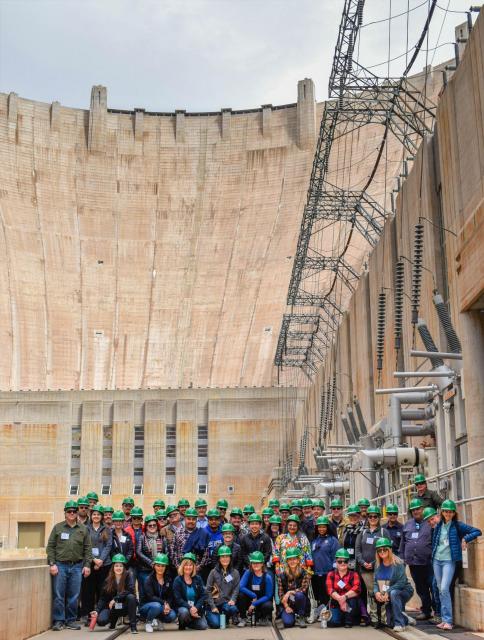
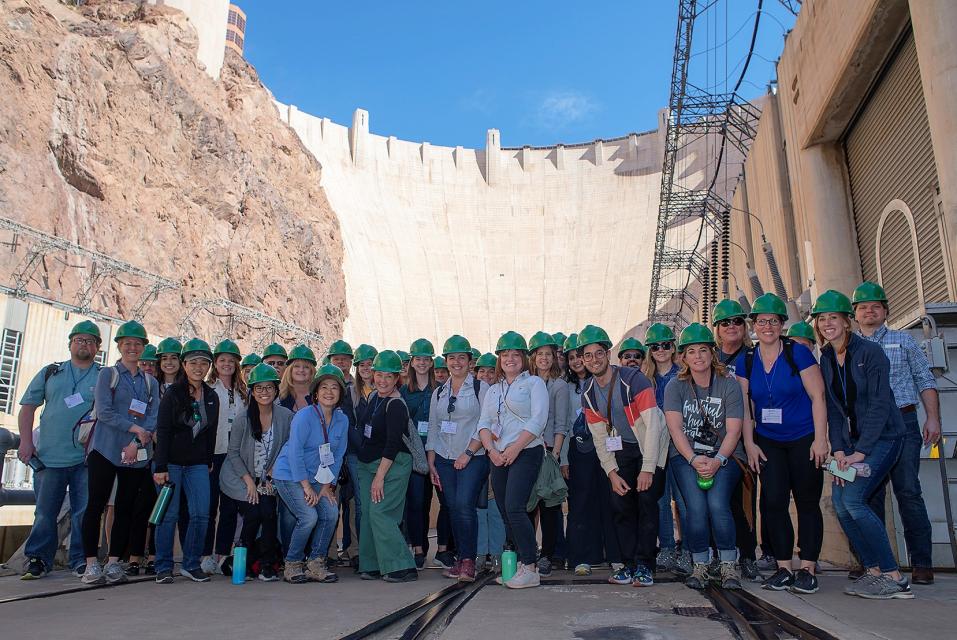
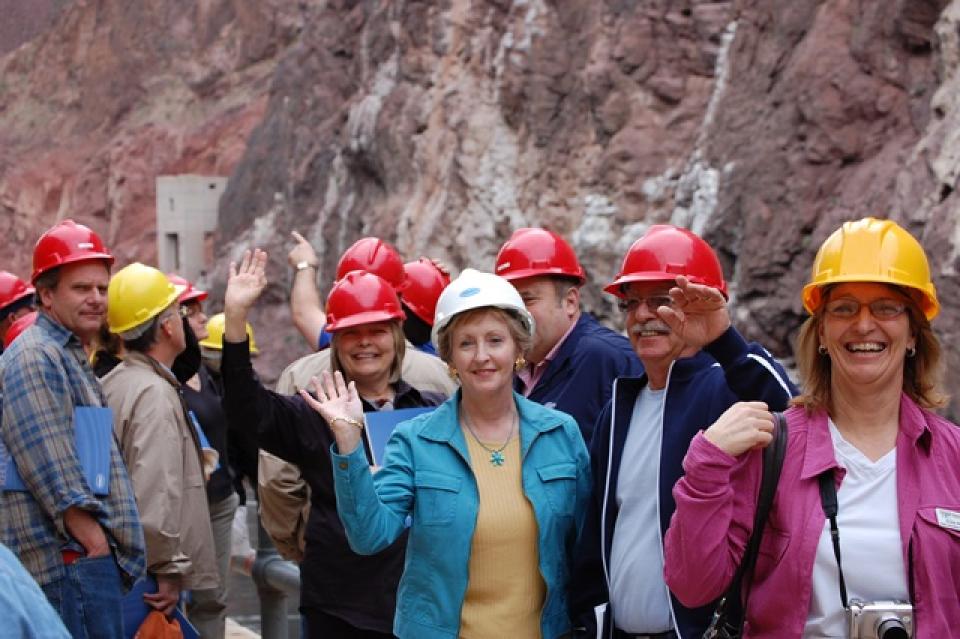
This tour explored the lower Colorado River firsthand where virtually every drop of the river is allocated, yet demand is growing from myriad sources — increasing population, declining habitat, drought and climate change.
The 1,450-mile river is a lifeline to some 40 million people in the Southwest across seven states, 30 tribal nations and Mexico. How the Lower Basin states – Arizona, California and Nevada – use and manage this water to meet agricultural, urban, environmental and industrial needs was the focus of this tour.
Hilton Garden Inn Las Vegas Strip South
7830 S Las Vegas Blvd
Las Vegas, NV 89123
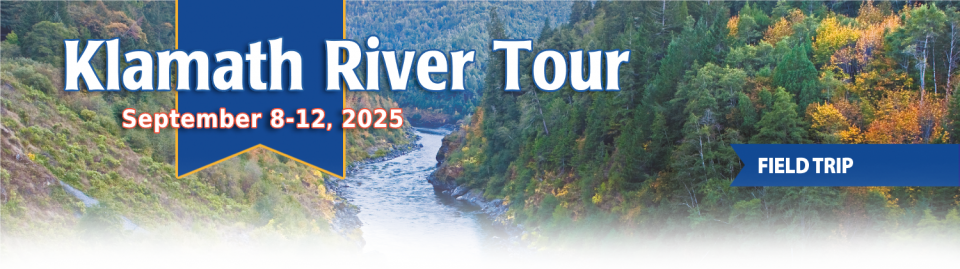
On this first-ever Foundation water tourwe examined water issues along the 263-mile Klamath River, from its spring-fed headwaters in south-central Oregon to its redwood-lined estuary on the Pacific Ocean in California.
Running Y Resort
5500 Running Y Rd
Klamath Falls, OR 97601
This tour explored the lower Colorado River firsthand where virtually every drop of the river is allocated, yet demand is growing from myriad sources — increasing population, declining habitat, drought and climate change.
The 1,450-mile river is a lifeline to some 40 million people in the Southwest across seven states, 30 tribal nations and Mexico. How the Lower Basin states – Arizona, California and Nevada – use and manage this water to meet agricultural, urban, environmental and industrial needs was the focus of this tour.
Hilton Garden Inn Las Vegas Strip South
7830 S Las Vegas Blvd
Las Vegas, NV 89123
Learn the history and challenges facing the West’s most dramatic
and developed river.
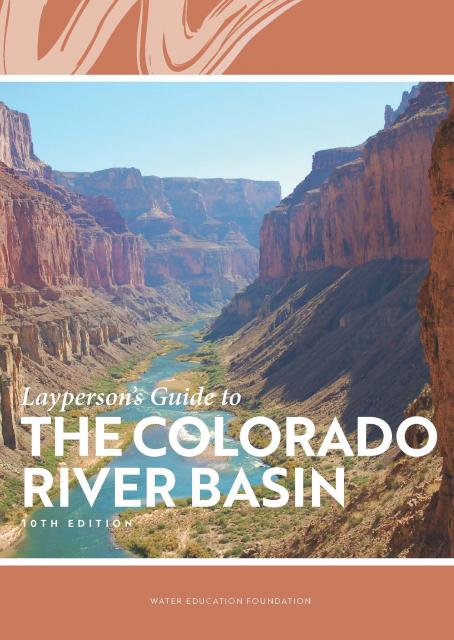
The Layperson’s Guide to the Colorado River Basin introduces the
1,450-mile river that sustains 40 million people and millions of
acres of farmland spanning seven states and parts of northern
Mexico.
The 28-page primer explains how the river’s water is shared and
managed as the Southwest transitions to a hotter and drier
climate.
This tour explored the lower Colorado River firsthand where virtually every drop of the river is allocated, yet demand is growing from myriad sources — increasing population, declining habitat, drought and climate change.
The 1,450-mile river is a lifeline to some 40 million people in the Southwest across seven states, 30 tribal nations and Mexico. How the Lower Basin states – Arizona, California and Nevada – use and manage this water to meet agricultural, urban, environmental and industrial needs was the focus of this tour.
Hilton Garden Inn Las Vegas Strip South
7830 S Las Vegas Blvd
Las Vegas, NV 89123
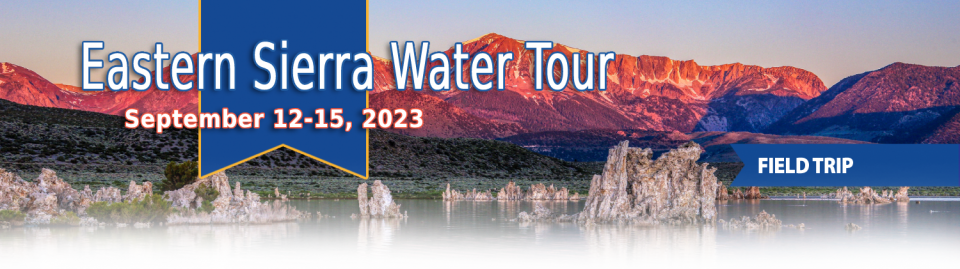
This special Foundation water tour journeyed along the Eastern Sierra from the Truckee River to Mono Lake, through the Owens Valley and into the Mojave Desert to explore a major source of water for Southern California, this year’s snowpack and challenges for towns, farms and the environment.
This tour explored the lower Colorado River firsthand where virtually every drop of the river is allocated, yet demand is growing from myriad sources — increasing population, declining habitat, drought and climate change.
The 1,450-mile river is a lifeline to some 40 million people in the Southwest across seven states, 30 tribal nations and Mexico. How the Lower Basin states – Arizona, California and Nevada – use and manage this water to meet agricultural, urban, environmental and industrial needs was the focus of this tour.
Hyatt Place Las Vegas At Silverton Village
8380 Dean Martin Drive
Las Vegas, NV 89139
The majestic beauty of the Sierra
Nevada forest is awe-inspiring, but beneath the dazzling blue
sky, there is a problem: A century of fire suppression and
logging practices have left trees too close together. Millions of
trees have died, stricken by drought and beetle infestation.
Combined with a forest floor cluttered with dry brush and debris,
it’s a wildfire waiting to happen.
Fires devastate the Sierra watersheds upon which millions of
Californians depend — scorching the ground, unleashing a
battering ram of debris and turning hillsides into gelatinous,
stream-choking mudflows.
We explored the lower Colorado River where virtually every drop
of the river is allocated, yet demand is growing from myriad
sources — increasing population, declining habitat, drought and
climate change.
The 1,450-mile river is a lifeline to 40 million people in
the Southwest across seven states and Mexico. How the Lower Basin
states – Arizona, California and Nevada – use and manage this
water to meet agricultural, urban, environmental and industrial
needs was the focus of this tour.
Hampton Inn Tropicana
4975 Dean Martin Drive, Las Vegas, NV 89118
This 30-minute documentary-style DVD on the history and current
state of the San Joaquin River Restoration Program includes an
overview of the geography and history of the river, historical
and current water delivery and uses, the genesis and timeline of
the 1988 lawsuit, how the settlement was reached and what was
agreed to.
This 25-minute documentary-style DVD, developed in partnership
with the California Department of Water Resources, provides an
excellent overview of climate change and how it is already
affecting California. The DVD also explains what scientists
anticipate in the future related to sea level rise and
precipitation/runoff changes and explores the efforts that are
underway to plan and adapt to climate.
20-minute DVD that explains the problem with polluted stormwater,
and steps that can be taken to help prevent such pollution and
turn what is often viewed as a “nuisance” into a water resource
through various activities.
Many Californians don’t realize that when they turn on the
faucet, the water that flows out could come from a source close
to home or one hundreds of miles away. Most people take their
water for granted; not thinking about the elaborate systems and
testing that go into delivering clean, plentiful water to
households throughout the state. Where drinking water comes from,
how it’s treated, and what people can do to protect its quality
are highlighted in this 2007 PBS documentary narrated by actress
Wendie Malick.
A 30-minute version of the 2007 PBS documentary Drinking Water:
Quenching the Public Thirst. This DVD is ideal for showing at
community forums and speaking engagements to help the public
understand the complex issues surrounding the elaborate systems
and testing that go into delivering clean, plentiful water to
households throughout the state.
Water truly has shaped California into the great state it is
today. And if it is water that made California great, it’s the
fight over – and with – water that also makes it so critically
important. In efforts to remap California’s circulatory system,
there have been some critical events that had a profound impact
on California’s water history. These turning points not only
forced a re-evaluation of water, but continue to impact the lives
of every Californian. This 2005 PBS documentary offers a
historical and current look at the major water issues that shaped
the state we know today. Includes a 12-page viewer’s guide with
background information, historic timeline and a teacher’s lesson.
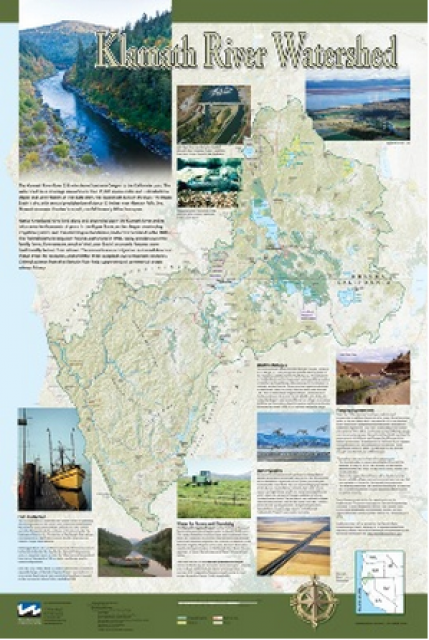
This beautiful 24×36-inch poster, suitable for framing, displays
the rivers, lakes and reservoirs, irrigated farmland, urban areas
and Indian reservations within the Klamath River Watershed. The
map text explains the many issues facing this vast,
15,000-square-mile watershed, including fish restoration;
agricultural water use; and wetlands. Also included are
descriptions of the separate, but linked, Klamath Basin
Restoration Agreement and the Klamath Hydroelectric Agreement,
and the next steps associated with those agreements. Development
of the map was funded by a grant from the U.S. Fish and Wildlife
Service.
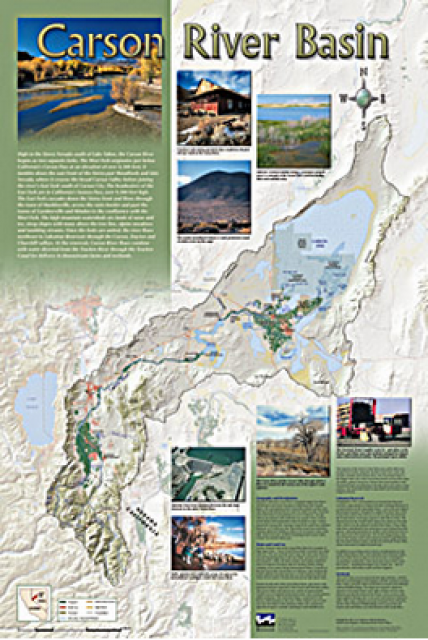
A companion to the Truckee River Basin Map poster, this
24×36-inch poster, suitable for framing, explores the Carson
River, and its link to the Truckee River. The map includes the
Lahontan Dam and reservoir, the Carson Sink, and the farming
areas in the basin. Map text discusses the region’s hydrology and
geography, the Newlands Project, land and water use within the
basin and wetlands. Development of the map was funded by a grant
from the U.S. Bureau of Reclamation Mid-Pacific Region, Lahontan
Basin Area Office.
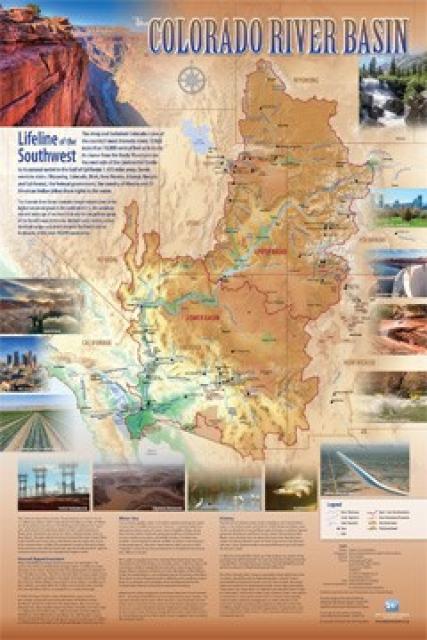
Redesigned in 2017, this beautiful map depicts the seven
Western states that share the Colorado River with Mexico. The
Colorado River supplies water to nearly 40 million people in
Arizona, California, Colorado, Nevada, New Mexico, Utah, Wyoming
and Mexico. Text on this beautiful, 24×36-inch map, which is
suitable for framing, explains the river’s apportionment, history
and the need to adapt its management for urban growth and
expected climate change impacts.
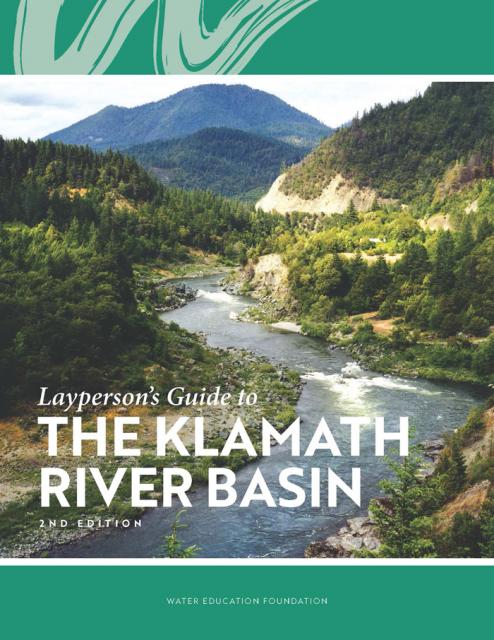
The Water Education Foundation’s second edition of
the Layperson’s Guide to The Klamath River Basin is
hot off the press and available for purchase.
Updated and redesigned, the easy-to-read overview covers the
history of the region’s tribal, agricultural and environmental
relationships with one of the West’s largest rivers — and a
vast watershed that hosts one of the nation’s oldest and
largest reclamation projects.
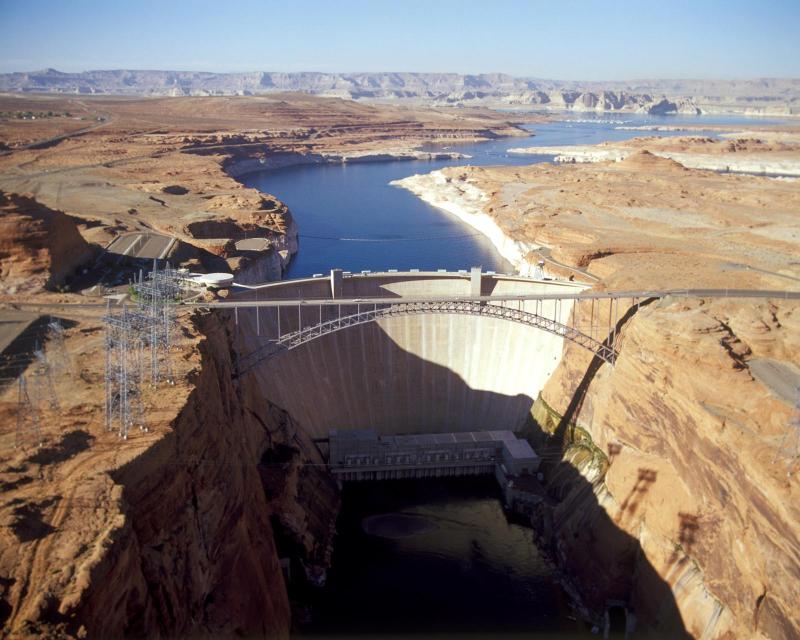
The construction of Glen Canyon Dam
in 1964 created Lake Powell. Both are located in north-central
Arizona near the Utah border. Lake Powell acts as a holding tank
for outflow from the Colorado River Upper Basin States: Colorado,
New Mexico, Utah and Wyoming.
The water stored in Lake Powell is used for recreation, power
generation and delivering water to the Lower Basin states of
California, Arizona, and Nevada.
Every five years the California Department of Water Resources
updates its strategic plan for managing the state’s water
resources, as required by state law.
The California Water Plan, or Bulletin 160, projects the
status and trends of the state’s water supplies and demands
under a range of future scenarios.
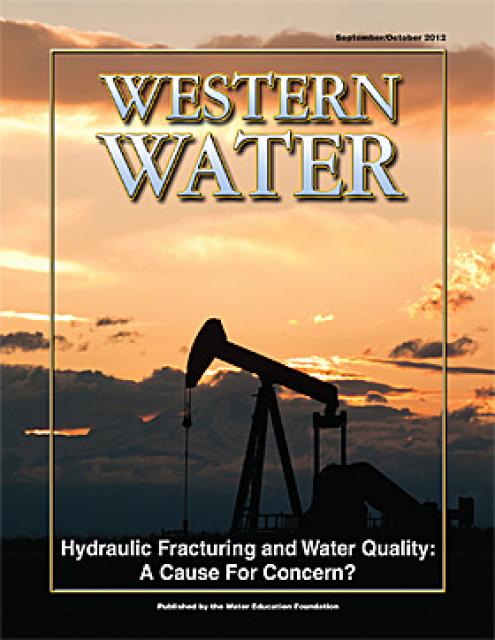
This printed issue of Western Water looks at hydraulic
fracturing, or “fracking,” in California. Much of the information
in the article was presented at a conference hosted by the
Groundwater Resources Association of California.
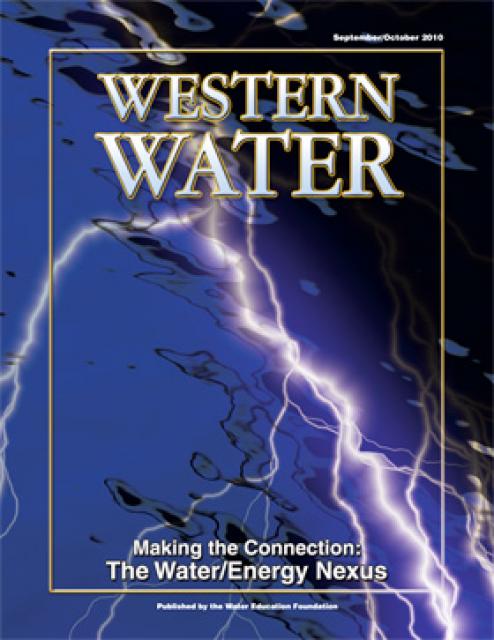
The connection between water and energy is more relevant than
ever. After existing in separate realms for years, the maxim that
it takes water to produce energy and energy to produce water has
prompted a re-thinking of management strategies, including an
emphasis on renewable energy use by water agencies.
This printed issue of Western Water looks at the energy
requirements associated with water use and the means by which
state and local agencies are working to increase their knowledge
and improve the management of both resources.
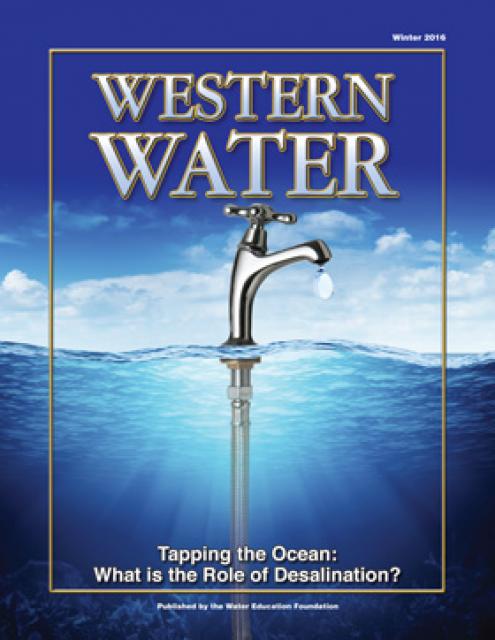
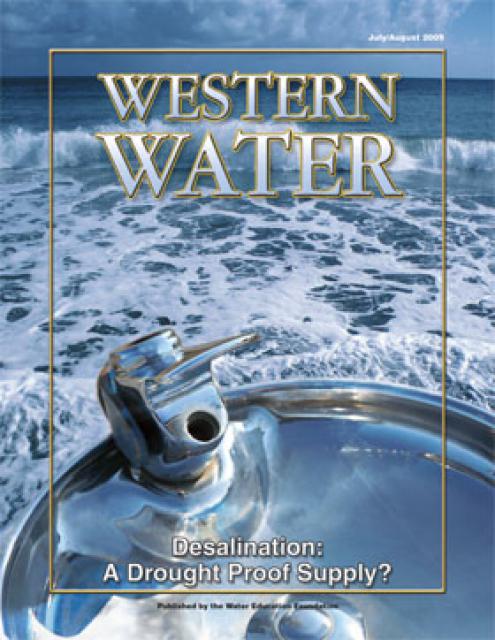
This printed issue of Western Water examines
desalination – an issue that is marked by great optimism and
controversy – and the expected role it might play as an
alternative water supply strategy.
This printed copy of Western Water examines climate change –
what’s known about it, the remaining uncertainty and what steps
water agencies are talking to prepare for its impact. Much of the
information comes from the October 2007 California Climate Change
and Water Adaptation Summit sponsored by the Water Education
Foundation and DWR and the November 2007 California Water Policy
Conference sponsored by Public Officials for Water and
Environmental Reform.
Hydropower generation is prevalent in the West, where rapidly
flowing river systems have been tapped for generations to produce
electricity. Hydropower is a clean, steady and reliable energy
source, but the damming of rivers has exacted a toll on the
environment, affecting, among other things, the migration of fish
to vestigial spawning grounds. Many of those projects are due to
be relicensed by the Federal Energy Regulatory Commission.
The California power crisis has made international headlines. But
what is the link between water and power in California? How is
the state’s dry spell affecting its hydropower generation? How
has the electric crisis affected water users in the state? These
questions and others are addressed in this issue of Western
Water.