



Mendota Pool
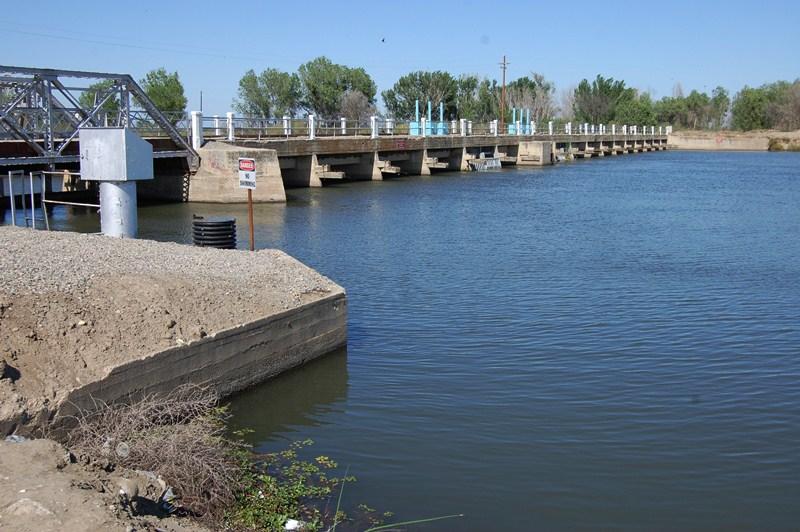
The Mendota Pool, located at the confluence of the San Joaquin River and the Fresno Slough in California’s San Joaquin Valley, is a historic piece of irrigation infrastructure that now plays a pivotal role for the federal Central Valley Project (CVP).
The Mendota Pool allows farms with historic water rights to the San Joaquin River to receive water from the Sacramento River as an exchange for the water they would otherwise take from the San Joaquin River. This “exchange” allowed the Bureau of Reclamation to build Friant Dam northeast of Fresno and divert that water to serve farms and cities on the east side of the San Joaquin Valley.
The pool, a historic diversion point for irrigation water, was first created in 1871 by an irrigation company controlled by the Miller & Lux cattle empire that spanned much of the San Joaquin Valley’s west side. The current concrete Mendota Dam was built in 1917, creating a small, 3,000-acre-foot reservoir extending into Fresno Slough, a distributary of the Kings River, 40 miles downstream of Friant Dam.
As part of the Central Valley Project, the Bureau of Reclamation agreed to deliver Sacramento River water to Mendota Pool via the 117-mile-long Delta-Mendota Canal.
Completed in 1951, the canal begins at the C.W. Bill Jones Pumping Plant near Tracy and follows the Coast Range south, providing irrigation water to the west side of the San Joaquin Valley, and terminating at Mendota Pool.
Here the Delta-Mendota Canal’s remaining water is released to replace San Joaquin River flows that have been diverted upstream by the Madera and Friant-Kern canals by where Friant Dam impounds the river in Millerton Lake.
As part of the San Joaquin River restoration, which is intended to restore salmon to the river, 10 miles of river passage leading up to the Mendota Pool are being widened. Plans also include a bypass around Mendota Pool to allow salmon to migrate.
Updated March 2026.